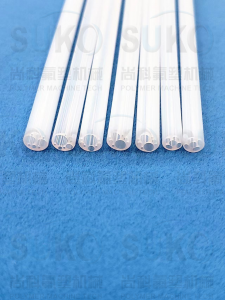
Multi-lumen tubing extrusion technology
The breakthrough in multi lumen medical tubing extrusion technology has promoted the application of medical tubes to a new level.
In the medical device industry, the minimally invasive surgery rends to require smaller and more innovative medical devices. Devices that act on blood vessels or other tissues require medical tubes with higher precision, tighter tolerances and additional functions. As the tubes are designed more complex, the extrusion technologies to produce them become more complicated. There is no doubt that the multi-lumen tubing extrusion technology is at the forefront of extrusion technology.
Multi-lumen extrusion or co-extrusion can be defined as the simultaneous extrusion of multiple layers of materials to produce multi-lumen medical tubes. Multi-lumen technology is primarily used to improve functionality: combining weldable materials with materials that have certain other performance characteristics, such as lubricity. These structures can also improve performance and potentially reduce overall assembly and material costs, making medical devices more cost-effective for customers; other features may include the addition of active material layers, such as hydrophilic, bioabsorbable or drug-eluting layers. The technologies and materials available to produce multilayer products for medical devices have greatly improved and offer designers a wide range of options for optimized size, material and function.
The functions of medical PTFE multi-lumen tubing in medical devices include: creating tubing surfaces with different characteristics for external and internal surfaces; combining materials with different characteristics to create unique tubing characteristics; enabling active materials to be optimally located; locating bondable materials internally or externally for self-assembly and easy assembly of complex medical devices.
The processing of multi-lumen tubes requires technicians to piece together a wide variety of extruders and downstream equipment. With this poor approach, it is likely that the various extruders will all be in the same plane, resulting in longer flow paths, increased extrusion pressure and increased material processing time. Under such processing method, the required tube layer ratios do not match the optimum output of the extruder, which can result in too high or low screw speeds, and further produce tubes with poor mechanical properties.
Modern multi-lumen tubing extrusion processing equipment is more likely to be a fully integrated production line with a single operator interface that monitors, controls and records the entire extrusion system in real time. Extruders for each polymer layer are selected to provide the desired range of output speeds that do not compromise the mechanical properties of the material. They are positioned to minimize material residence time, and typically one or more extruders can be mounted vertically or at a 45° angle. Typically, one or more extruders in a multi-lumen system will be micro-extruders with a minimum output of 50 grams per hour, allowing an individual layer to be just a few microns thick. Manufacturers of these micro-extruders use innovative extruder designs to ensure that standard plastic pellets travel well through the feed section of the extruder without loss of stability.
Customer expectations are driving the massive use of such statistical process control system and increasing product requirements from regulatory agencies. However, accurate in-line measurement of thin wall medical tubing remains a considerable challenge for medical device manufacturers.
There are still quite a few thermoplastic materials that can be used to design multi-lumen tubes. The most commonly used materials are those traditionally used to make medical tubing, such as polyamide (PA), thermoplastic elastomer (TPE), polyurethane (PU), polyvinyl chloride (PVC), and polyolefin (PE). These materials can be customized to include drug-eluting components, radioactive materials, fillers, and/or colors. However, the designer must consider the processing temperature, flow characteristics and melt viscosity of the material.
Multi-lumen tubing extrusion technology is particularly suitable for extruding novel or active expensive materials that have specific functions because it allows for proper design of the placement of these materials on the medical tubing. A common example is: placing drug-eluting materials on the outer layer of the tubing or placing highly lubricated materials on the inner layer of the tubing. Furthermore, multi lumen medical tubing has cost advantages because thin layers can be placed in the most effective locations.
Applications of multi-lumen tubing in medical industry
Percutaneous replacement of a diseased heart valve is an emerging therapy that offers an alternative to traditional surgical approaches for high-risk patients. In this minimally invasive procedure, a guide wire is passed through the femoral entry site and guided into the heart chambers. A guide sheath is inserted over the guide wire, and the valve delivery system is introduced. The medical tubing required to deliver the valve to the site is a highly specialized component. The distal end must be easily manipulated so that it can be guided directly into the cardiac chamber. The proximal end needs to be more rigid, must have excellent kink resistance, and the inner diameter needs to be lubricated for smooth and unobstructed delivery of replaced valves. Another key requirement is that the wall should be as thin as possible to maximize the delivery path diameter of the replaced valve without the tube losing any of its function.
Designers faced many challenges in designing this particular component. PTFE lubricated liners usually meet the industry standard for delivery systems, but cannot be used due to the possible effects of gamma radiation during sterilization. To ensure that the medical tubing does not kink or deform as it is guided through the anatomy to the heart, a braided layer must be incorporated into the component.
The final design is a five-layer assembly consisting of an ultra-thin-walled multi lumen medical tubing, a braided layer of stainless steel and polyether block amide sheaths of various hardnesses, adding overall proximal to distal flexibility to the outer layer of the assembly.
Conclusion
The innovative use of multi-lumen tubing in medical design has revolutionized the way we solve a large number of medical problems. In the future, as extrusion tools and machine design techniques become more advanced, coupled with improvements in process control and measurement systems, SuKo, one of China top 10 medical tubing companies expect to achieve greater precision with smaller, thinner and more versatile multi-lumen tubes. Over time, multi-lumen extrusion production lines will become more specialized and other extrusion technologies are incorporated such as multi-lumen extrusion, tapered extrusion, and intermittent/interrupted extrusion.