mail: info@sukoptfe.com
Showing posts with label gasket. Show all posts
Showing posts with label gasket. Show all posts
Thursday, July 21, 2022

Tuesday, June 28, 2022
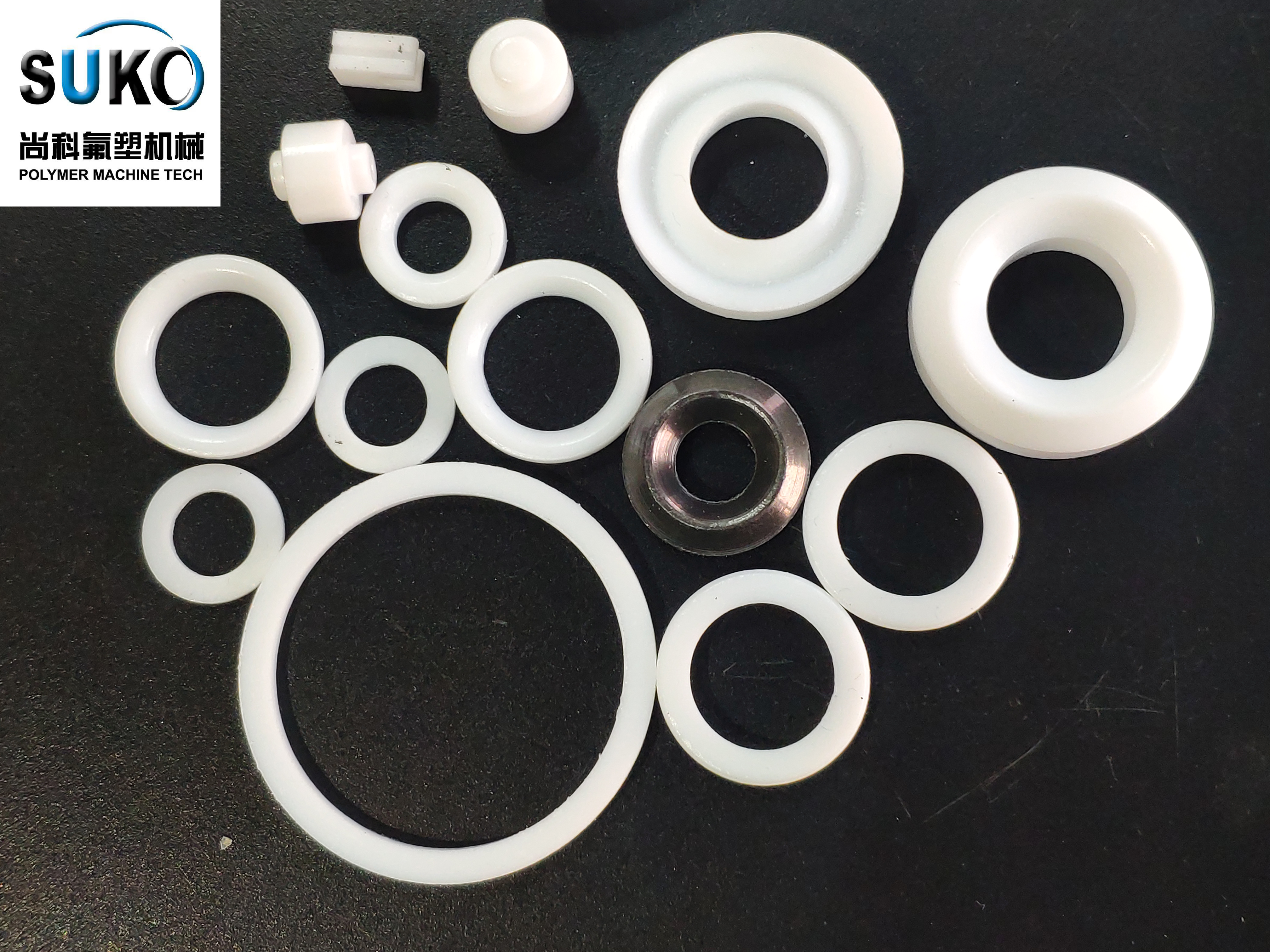
Best cutting solution for sealing PTFE gaskets
PTFE gaskets, also known as Teflon gaskets, are widely used as sealing and filling materials in petroleum, chemical, pharmaceutical, electric power, steel and other industries for their excellent material properties. And the great empowering values created by Teflon gaskets should not be underestimated. Today, let’s talk about knowledge about PTFE gaskets and PTFE gasket molding equipment.
Teflon gasket is a polymer compound made of tetrafluoroethylene by polymerization, which has excellent chemical stability, corrosion resistance, sealing, non-toxicity, high lubrication, non-adhesion, electrical insulation, age resistance, and many other excellent characteristics. Therefore, it has been widely used in various applications.
As one of the best corrosion resistant materials, PTFE gasket has solved many problems in the areas of chemical, petroleum and pharmaceutical. Meanwhile, it has a variety of applications as a sealing material. How to better cut and process PTFE to solve the problems of complicated punching operations, serious material wastes, low utilization rate and secondary grinding processing has become the key focus of many gasket manufacturers.
With the market becoming intelligent and mechanized, manual operation has been gradually replaced by machines, and laser machine, an insulation cutting machine, is not suitable for the cutting of all the materials, which will easily produce odor or material damage, thus reducing sales volume.
Highly efficient and accurate PTFE gasket automatic press molding machines are designed to improve production efficiency and product quality, and promote the green and sustainable development of the production chain. This kind of machine can meet customers’ needs and guarantee product quality in a more efficient and precise manner in the era of intelligent automation.
Established in 2006, Suko has over 13 years of manufacturing experience in PTFE/UHMWPE extrusion machinery and equipment for special applications in the field of plastics processing, and stays forefront of the Tetrafluorohydrazine industry with technology innovation, profession and intelligence both domestically and abroad.
|
Friday, July 12, 2019
Study on Sintering of Ptfe
From the
perspective of the three factors that determine the properties of PTFE products
-- molecular weight, crystallinity and voidage, the voidage is mainly affected
by the preforming pressure, and the molecular weight and crystallinity all
change with the different sintering conditions. Therefore, sintering process
conditions play a decisive role in the final properties of products such as
density, hardness, permeability and mechanical properties.
Wang
ping found that the sintering process of PTFE was affected by the rising and
falling speed, sintering temperature and sintering time. The larger the
product, the slower the speed of rising and cooling, the longer the sintering
time. The sintering temperature of suspension resin is higher than that of
dispersion resin. The sintering temperature of pure material products is higher
than that of filled products. In general, the rate of warming is faster than
the rate of cooling. In the same sintering furnace, pure material and filling
products cannot be mixed; Products with different sintering conditions cannot
be mixed. Products of different raw materials cannot be mixed. Taking the
production of 3-layer molded circular plate with diameter of 1 m, thickness of
20 mm, double layer as pure ptfe and middle layer as filled ptfe as an example,
the compression strength, bending strength, hardness and other mechanical
properties of the circular laminated plate produced by this technology have
been greatly improved.
Liu
xianlan studied the forming process characteristics, forming method and mold
design characteristics of PTFE, analyzed the defects and causes of PTFE
products produced by cold pressing and sintering, and put forward the treatment
methods. PTFE can be molded by a variety of preforming processes, such as
molding, extrusion, hydraulic molding, push molding and secondary processing,
and then sintered to the final product.PTFE molding is mostly made of suspended
resin. When the thickness of sheet is less than 1.5mm, disperse resin is used. Its
technological process: resin - sieve (suspension resin after pounding, loose,
and the 20 mesh mesh sieve) - press (PTFE powder loading the mould under
pressure from 20 to 35 MPa, after press compaction forming) - sintering (in 370
~ 380 "C temperature sintering in sintering furnace) - moulded products
(under free state within the mold or after cooling to finalize the design as
required by the board, rods, tubes, gaskets and packing products,
etc.).Hydraulic method is also called the equilibrium method or rubber molding
in its operating process is: put rubber bag in die - connected to the water
pump, filling the water swell the rubber bag into a cylindrical - resin evenly
join between bag and external mold mold closing - continue to gradually
increase the water pressure, water filling up to 12 ~ 13 mpa pressure
maintaining 30 min: after water - decompression, ripping, sintering, cooling is
the use of bright and clean appearance. Push is also called the paste extrusion
molding, 20 ~ 30 mesh sieve dispersion resin and organic liquid (such as
toluene, petroleum ether, the solvent oil) mixture 1:5 paste mixture,
preloading into thick wall cylinder billet, push into the compressor cylinder,
heating, with a plunger push molding, after drying in the 360 ~ 380 ° C
temperature sintering, after cooling products have strong push tube, rod,
etc.Extrusion molding can be divided into two types: screw extrusion and
plunger extrusion. The pre-sintered resin after crushing and sifted is added to
the material cylinder. Through screw rotation or reciprocating push of plunger,
the raw material is transported to the extruder at the same time of compaction.
Wang
ping studied the forming process of PTFE foam material. Suspended
polytetrafluoroethylene is used as raw material, and condensed cyclic aromatic
hydrocarbons are selected as pore-forming agent. After mixing, preforming
products are preformed and sintered. At the initial stage of sintering, drying
process is adopted to make pore-forming agent escape, and then resintering
stage is entered. Foam materials with different dielectric constants can be
prepared in different proportions to meet various requirements.
Chen xu
et al. conducted compression test and sintering test on PTFE, discussed the
relationship between density, compression strength and compression modulus, and
analyzed the compression strength of specimens under different sintering
processes, and obtained more appropriate molding pressure and sintering
process. The results showed that the compression strength of PTFE decreased
with the increase of pressing pressure, and the compression modulus increased
with the increase of pressing pressure. The molding pressure was 27.5mpa,
sintering temperature was 380 C, and the insulation time was 4h.
In order
to overcome the disadvantages of pure ptfe, such as poor abrasion resistance
and large thermal expansion coefficient, Raytheon studied the bronze-filled
particles in ptfe, and expanded the application scope of ptfe. The conventional
warm pressing molding of ptfe is characterized by long cycle, poor performance,
low dimensional accuracy and smoothness, while the warm pressing molding in
this study has fewer working procedures, short cycle and significantly improved
mechanical properties.

Thursday, July 4, 2019
The molding process of the press automatic Moulding Machine
Is moulded plastic processing and molding
the application in the city one of the oldest technology. It has a mature
production technology, equipment and mold is simple, easy to forming large
products, can use multiple modes to improve the production of small parts, etc,
in machinery, electronics, transportation and daily life, and many other fields
has been widely used.
The market will often see a lot of kinds of
Press Moulding Machine, for example: Polymer/PTFE Bush press Automatic Moulding Machine, Polymer/PTFE Flange press Automatic Moulding
Machine, Polymer/PTFE gasket automatic Moulding
Machine, Semi-automatic Molding Machine and so on.
Molding is widely used in the following
fields:
Electrical: insulator, switch box,
electrical equipment housing, insulation tools, wiring board, etc.
Automobile: lamp shade, front and rear
bumper, battery bracket, engine soundproof board, etc.
Railway: window frame of vehicle, toilet components,
seats, table tops, siding and roof of carriage, etc.
Construction: water tank, bath products,
door panels, purification tank, building template, etc.
Bathroom: bathtub, integral bathroom
equipment, integrated wash basin, etc.
And other areas of industry and
agriculture.
Molding technology is a method of putting
quantitative molding materials (powder, granular or fibrous plastic) into the
metal mold and forming products under the action of temperature and pressure. During
the molding process, heat and pressure are required to melt (or plasticize) the
molding material, fill the mold cavity with flow, and make the resin solidify. The
principle is that the process of pressurizing, shaping and heating depends on
the closure of the heated mold.
Moulding Machine technology is the oldest molding
method in plastic processing technology. Because of its long history, the
molding technology has been quite mature, at present in thermosetting plastics
and some thermoplastic plastics (fluoroplastics, uhmwpe, polyimide, etc.)
processing is still the most widely used and the main position of the molding
method. Moulded thermosetting plastic, placed in the cavity of the
thermosetting plastic under the action of heat, first changed from solid to
melt, melt flow under pressure with the shape of the cavity and cavity has
given, as the crosslinking reaction, resin molecular weight increased, the
curing degree rise, moulding material viscosity increase gradually and becomes
solid, finally becomes demoulding products. Thermoplastic plastic mold
pressure, in the previous stage of the situation and thermosetting Plastic the
same, but because there is no cross-linking reaction, so in the flow of full
cavity, the mold must be cooled to make its molten plastic into a solid with a
constant strength can be demodulated into products. Because thermoplastic
plastic mold pressing mold needs to alternately heating and cooling, production
cycle is long, so thermoplastic products generally choose injection molding
method more economic, only in the mold larger plane of Plastic products or
because of the flow of thermoplastic plastic injection molding method is
difficult to use molding.
In the mold press material filled with the
mold cavity flow process, not only the resin flow, the reinforcement material
also to flow, so the mold press molding process molding pressure is higher than
other process methods, belongs to the high pressure molding. Therefore, it
needs not only the hydraulic press which can control the pressure, but also the
high strength, high precision and high temperature resistant metal die.

Subscribe to:
Posts (Atom)